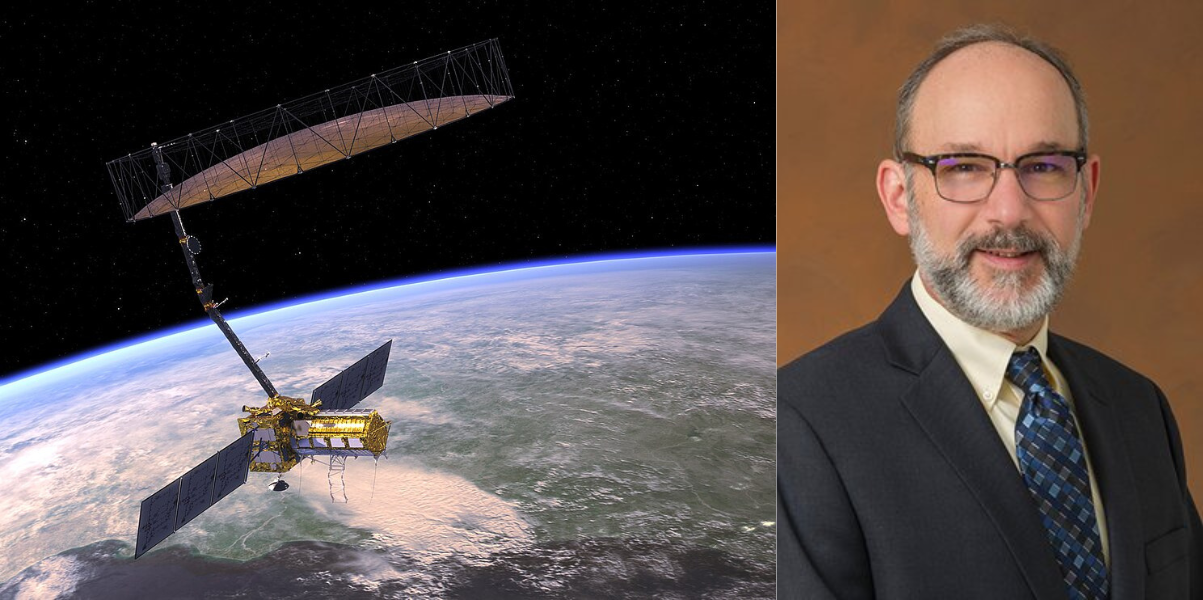
With its open-data policy and systematic global mapping strategy, NISAR is poised to provide a foundational dataset for the global Earth Observation community, enabling more informed decision-making in the face of environmental change.
The NASA-ISRO SAR (NISAR) mission, a pioneering collaboration between the United States and India, marks a significant leap in our ability to monitor Earth's complex processes. As the first hardware-integrated dual-frequency (L-band and S-band) radar mission, NISAR will provide a global, high-resolution temporal record of the planet’s changing crust, ice sheets, and ecosystems.
Join us on Friday 15 May for a midday AEST talk led by Dr Paul A Rosen.
About Dr Rosen:
Dr Rosen is a Project Scientist at NASA’s Jet Propulsion Laboratory (JPL) and a leading international expert in Radar Science and Engineering. With over 35 years of experience in Earth and planetary remote sensing, Dr. Rosen currently serves as the NASA Project Scientist for the NASA-ISRO SAR (NISAR) mission - a landmark partnership between the United States and India to provide global, high-resolution measurements of Earth's changing ecosystems, dynamic surfaces, and ice masses.
This talk will provide a high-level overview of the mission’s primary science objectives, which include measuring surface deformations with sub-centimetre precision to better understand natural hazards—such as earthquakes, volcanoes, and landslides—as well as tracking the dynamics of sea ice and glaciers. Dr. Rosen will also discuss NISAR’s role in biomass estimation and carbon cycle monitoring.